

Global Neuromodulation Devices Market Anticipating Remarkable Growth at a CAGR of ~9% by 2032 | DelveInsight
The neuromodulation devices market is expanding swiftly, propelled by the increasing global incidence of chronic conditions such as pain, epilepsy, and depression. This growth is further supported by notable technological innovations that have enhanced device efficiency, miniaturization, and intelligence. In addition, supportive regulatory frameworks and improved reimbursement policies are making these therapies more widely available. Overall, the growing need for effective, long-term treatments for neurological and chronic disorders is driving robust, enduring market expansion.
New York, USA, Feb. 23, 2026 (GLOBE NEWSWIRE) -- Global Neuromodulation Devices Market Anticipating Remarkable Growth at a CAGR of ~9% by 2032 | DelveInsight
The neuromodulation devices market is expanding swiftly, propelled by the increasing global incidence of chronic conditions such as pain, epilepsy, and depression. This growth is further supported by notable technological innovations that have enhanced device efficiency, miniaturization, and intelligence. In addition, supportive regulatory frameworks and improved reimbursement policies are making these therapies more widely available. Overall, the growing need for effective, long-term treatments for neurological and chronic disorders is driving robust, enduring market expansion.
DelveInsight’s Neuromodulation Devices Market Insights report provides the current and forecast market analysis, individual leading neuromodulation devices companies’ market shares, challenges, neuromodulation devices market drivers, barriers, trends, and key neuromodulation devices companies in the market.
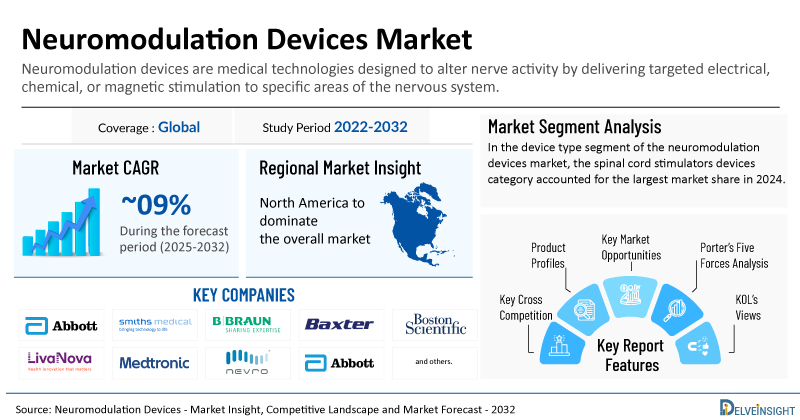
Neuromodulation Devices Market Summary
- 2024 Neuromodulation Devices Market Size: USD 7.8 Billion
- 2032 Projected Neuromodulation Devices Market Size: USD 16.1 Billion
- Neuromodulation Devices Market Growth Rate (2025-2032): ~9%
- Largest Neuromodulation Devices Market: North America
- Largest Device Type Segment: Spinal Cord Stimulators Devices Category
- Key Companies in the Neuromodulation Devices Market: Abbott Laboratories, Smith’s Medical, B. Braun Melsungen AG, Baxter International Inc., Boston Scientific Corp., LivaNova PLC., Medtronic, Nevro Corp., Abbott, Stryker, Omron Corporation, Stimwave LLC, Koninklijke Philips NV, Kimberly Clark Corporation, EndoStim Inc., Aleva Neurotherapeutics SA, Cyberonics, DyAnsys, Inc., NanoVibronix, Inc., ElectroCore Inc., and others
To read more about the latest highlights related to the neuromodulation devices market, get a snapshot of the key highlights @ https://www.delveinsight.com/sample-request/neuromodulation-devices-market?utm_source=globenewswire&utm_medium=pressrelease&utm_campaign=spr
Key Factors Contributing to the Rise in Growth of the Neuromodulation Devices Market
- Rising Prevalence of Neurological Disorders: Conditions like chronic pain, epilepsy, Parkinson's disease, treatment-resistant depression, and essential tremor are increasing globally, particularly with aging populations, driving demand for neuromodulation therapies.
- Technological Advancements: Innovations such as miniaturized, rechargeable, closed-loop, and non-invasive devices improve efficacy, patient comfort, battery life, and precision targeting of neural circuits.
- Growing Geriatric Population: An expanding elderly demographic heightens the incidence of chronic pain and neurodegenerative diseases, boosting the need for long-term neuromodulation solutions.
- Favorable Regulatory and Reimbursement Policies: Supportive frameworks, approvals, and improved coverage in regions such as North America and Europe enhance accessibility and adoption.
- Robust Healthcare Infrastructure: Advanced facilities, specialized clinics, and trained neurosurgeons in key markets facilitate the implantation and management of these devices.
- Increasing Demand for Minimally Invasive Options: Preference for targeted, drug-free alternatives to traditional treatments with fewer systemic side effects fuels market expansion.
Get a sneak peek at the neuromodulation devices market dynamics @ Neuromodulation Devices Market Trends
Regional Neuromodulation Devices Market Insights
North America
- Accounted for a dominant ~55% share of the global neuromodulation devices market in 2024, led by the U.S.
- Strong regional leadership driven by a highly favorable ecosystem for development, adoption, and commercialization of neuromodulation technologies.
- Well-established healthcare infrastructure, including advanced surgical centers, specialized neurological clinics, and extensive hospital networks.
- Enables early adoption of innovative medical devices and safe, effective performance of complex procedures such as neurostimulator implantation.
- Large and consistent patient base with high prevalence of chronic pain, Parkinson’s disease, epilepsy, and treatment-resistant depression, driving sustained demand for advanced therapeutic options.
Europe
- Ranked as the second-largest market globally, accounting for approximately 21% of the market share in 2024.
- Market growth is supported by the rising prevalence of chronic neurological conditions and an aging population.
- Significant patient pool for indications such as Parkinson’s disease, chronic pain, and epilepsy.
- Technological innovation remains a key growth driver, including the adoption of smart, closed-loop systems and smaller, rechargeable, and non-invasive devices.
- Established regulatory and reimbursement frameworks in major European countries support technology adoption despite regional complexity.
- Strong presence of global industry leaders fuels continuous innovation and frequent product launches.
Asia-Pacific
- Emerging as the fastest-growing regional market, with a projected CAGR exceeding 12%.
- Increasing burden of neurological disorders such as epilepsy, Parkinson’s disease, and chronic pain across the region.
- Rapidly aging populations in countries like Japan and China significantly contribute to rising demand.
- Growing acceptance of advanced medical technologies is supported by increased R&D activity and a shift toward minimally invasive procedures.
- Integration of smart technologies, including AI and machine learning, is enabling more personalized neuromodulation therapies.
- Supportive government initiatives, including increased research funding, streamlined regulatory pathways, and public health programs, are accelerating market growth.
To know more about why North America is leading the market growth in the neuromodulation devices market, get a snapshot of the Neuromodulation Devices Market Share
Recent Developmental Activities in the Neuromodulation Devices Market
- In January 2026, the U.S. FDA cleared ProlivRx as the first prescription, at-home neuromodulation therapy for the brain, approved as an add-on treatment for adults with depression that has shown inadequate response to antidepressant medications. Developed by Neurolief, the device uses noninvasive, focal, multi-channel external combined occipital and trigeminal afferent stimulation (eCOT-AS) to engage neural pathways associated with mood regulation.
- In September 2025, Vivani Medical, Inc. disclosed that its board of directors had established the record date for the authorized spin-off of Cortigent, Inc. (“Cortigent”), a wholly owned subsidiary focused on developing advanced neuromodulation–based brain implant devices.
- In June 2025, Neuspera Medical’s integrated sacral neuromodulation (iSNM) system received FDA approval for the treatment of urinary urge incontinence (UUI) without an implantable battery, offering a more comfortable patient experience.
- In March 2025, Newronika’s AlphaDBS, a next-generation closed-loop adaptive DBS system, received CE Mark.
- In February 2025, the U.S. FDA approved Medtronic's BrainSense Adaptive Deep Brain Stimulation (aDBS) system, the first of its kind for the treatment of Parkinson's disease.
What are Neuromodulation Devices?
Neuromodulation devices are medical technologies designed to alter nerve activity by delivering targeted electrical, chemical, or magnetic stimulation to specific areas of the nervous system. These devices work by modulating neural signals to restore normal function or reduce abnormal activity associated with various neurological and chronic conditions. Commonly used in the treatment of disorders such as chronic pain, Parkinson’s disease, epilepsy, depression, and urinary incontinence, neuromodulation devices can be implanted (such as deep brain stimulators or spinal cord stimulators) or non-invasive (such as transcranial magnetic stimulation systems). By offering adjustable, reversible, and often personalized therapy options, neuromodulation devices provide an important alternative to long-term medication or invasive surgical interventions.
| Neuromodulation Devices Market Report Metrics | Details |
| Coverage | Global |
| Study Period | 2022–2032 |
| Neuromodulation Devices Market CAGR | ~9% |
| Neuromodulation Devices Market Size by 2032 | USD 16.1 Billion |
| Key Neuromodulation Devices Companies | Abbott Laboratories, Smith’s Medical, B. Braun Melsungen AG, Baxter International Inc., Boston Scientific Corp., LivaNova PLC., Medtronic, Nevro Corp., Abbott, Stryker, Omron Corporation, Stimwave LLC, Koninklijke Philips NV, Kimberly Clark Corporation, EndoStim Inc., Aleva Neurotherapeutics SA, Cyberonics, DyAnsys, Inc., NanoVibronix, Inc., ElectroCore Inc., and others |
Neuromodulation Devices Market Assessment
-
Neuromodulation Devices Market Segmentation
- Neuromodulation Devices Market Segmentation By Device Type: Spinal Cord Stimulators, Deep Brain Stimulators, Sacral Nerve Stimulators, Vagus Nerve Stimulators, and Others
- Neuromodulation Devices Market Segmentation By Application: Pain Management, Urinary & Faecal Incontinence, Neurological Disorders, Respiratory Disorders, and Others
- Neuromodulation Devices Market Segmentation By Type: Invasive, Non-Invasive
- Neuromodulation Devices Market Segmentation By End User: Hospitals, Specialty Clinics, and Others
- Neuromodulation Devices Market Segmentation By Geography: North America, Europe, Asia-Pacific, and Rest of World
- Porter’s Five Forces Analysis, Product Profiles, Case Studies, KOL’s Views, Analyst’s View
Which MedTech key players in the neuromodulation devices market are set to emerge as the trendsetter explore @ Neuromodulation Devices Market Analysis
Table of Contents
| 1 | Neuromodulation Devices Market Report Introduction |
| 2 | Neuromodulation Devices Market Executive Summary |
| 3 | Competitive Landscape |
| 4 | Regulatory Analysis |
| 5 | Neuromodulation Devices Market Key Factors Analysis |
| 6 | Neuromodulation Devices Market Porter’s Five Forces Analysis |
| 7 | Neuromodulation Devices Market Layout |
| 8 | Neuromodulation Devices Market Company and Product Profiles |
| 9 | KOL Views |
| 10 | Project Approach |
| 11 | About DelveInsight |
| 12 | Disclaimer & Contact Us |
Interested in knowing the neuromodulation devices market share by 2032? Click to get a snapshot of the Neuromodulation Devices Market Size
Related Reports
Spinal Cord Stimulators Market
Spinal Cord Stimulators Market Insights, Competitive Landscape and Market Forecast – 2032 report delivers an in-depth understanding of market trends, market drivers, market barriers, and key spinal cord stimulators companies, including Boston Scientific Corporation, Medtronic, Abbott, Nevro Corp, Cirtec Medical, Stimwave LLC, NeuroSigma, Inc., Synapse Biomedical, Inc., Greatbatch, Inc., Saluda Medical Pty Ltd., Beijing PINS Medical Co., Ltd., among others.
Deep Brain Stimulation Devices Market
Deep Brain Stimulation Devices Market Insights, Competitive Landscape and Market Forecast – 2032 report delivers an in-depth understanding of market trends, market drivers, market barriers, and key deep brain stimulation devices companies, including Abbott Laboratories, Medtronic, Boston Scientific Corporation, Aleva Neurotherapeutics, Renishaw plc, NeuroPace, Inc., NeuroSigma, Inc., Elekta, LivaNova PLC, SceneRay Co., Ltd., Synapse Biomedical, BrainsWay, Magstim, Newronika S.p.A., Brainlab AG, Functional Neuromodulation, Ltd., Theranica Bio-Electronics Ltd., Precisis GmbH, Neuros Medical, Magnus Medical, Inc., among others.
Sacral Nerve Stimulator Devices Market
Sacral Nerve Stimulator Devices Market Insights, Competitive Landscape and Market Forecast – 2032 report delivers an in-depth understanding of market trends, market drivers, market barriers, and key sacral nerve stimulator devices companies, including Medtronic, Axonics, Inc., Boston Scientific Corporation, NeuroPace, Inc., Laborie, Biegler GmbH, Finetech Medical, among others.
Vagus Nerve Stimulators Market
Vagus Nerve Stimulators Market Insights, Competitive Landscape and Market Forecast – 2032 report delivers an in-depth understanding of market trends, market drivers, market barriers, and key vagus nerve stimulators companies, including LivaNova, Soterix Medical Inc., MicroTransponder Inc., Parasym Ltd., electroCore, tVNS Technologies GmbH, among others.
Neurovascular Devices Market Insights, Competitive Landscape and Market Forecast – 2032 report delivers an in-depth understanding of market trends, market drivers, market barriers, and key neurovascular devices companies, including Johnson & Johnson Services Inc., Medtronic, Stryker, Terumo Corporation, Penumbra, Inc., Microport Scientific Corporation, Kaneka Corporation, Integer Holdings Corporation, phenox GmbH, Perflow Medical Ltd., Balt, Rapid Medical, ASAHI INTECC CO., LTD., Acandis GmbH, Cerus Endovascular Inc., among others.
About DelveInsight
DelveInsight is a leading Business Consultant, and Market Research firm focused exclusively on life sciences. It supports pharma companies by providing comprehensive end-to-end solutions to improve their performance.

Contact Us

Shruti Thakur

info@delveinsight.com

+14699457679

Legal Disclaimer:
EIN Presswire provides this news content "as is" without warranty of any kind. We do not accept any responsibility or liability for the accuracy, content, images, videos, licenses, completeness, legality, or reliability of the information contained in this article. If you have any complaints or copyright issues related to this article, kindly contact the author above.
